


You get hurt in a wreck, Google a few symptoms, and before you know it, you are typing questions into an AI chatbot:
“Do I really need a lawyer?”
“Can AI tell me what my case is worth in Louisiana?”
If this sounds familiar, you are not alone. As AI tools become part of everyday life, more people across the Acadian region, from Lafayette and Metairie to Baton Rouge, are testing “AI legal advice” before they talk to a real lawyer.
As a Louisiana personal injury lawyer born and raised in Lafayette, Blaine and his team know how tempting it is to look for quick, free answers. We also know where AI can help and where it can quietly hurt your claim.
In this article, we will explain a personal injury lawyer’s take on how to use AI programs (ex. ChatGPT) to assist you with an injury claim.
Key Takeaways
- AI is helpful for learning basics, but it cannot apply Louisiana law to your exact situation.
- AI can’t represent you, negotiate with insurers, or protect your rights in court.
- Louisiana law is unique, and generic AI answers may incorrectly cite rules from other states.
- Your chats may not be private; avoid pasting full reports or medical records into AI tools.
- AI works best as a starting point, not as your main source of legal guidance.
- AI tools often lack the context needed to fully understand the nuances of your case, which can lead to incomplete or misleading advice.
- A real Louisiana lawyer sees the full picture: your injuries, your work life, your family impact, and local adjuster behavior.
- Talking to Blaine is free, local, and focused on getting your claim handled the right way.
What “AI Legal Advice” Really is
When people say “AI legal advice,” they usually mean one of three things:
- Typing a question into a chatbot like ChatGPT
- Using an “AI lawyer” app or website that offers fast, general answers
- Reading an AI-generated summary at the top of a Google search result
These tools pull from large pools of information. Some focus on legal topics. Some are general-purpose.
Most of them clearly state that they:
- Give general legal information only
- Are not a law firm
- Are not giving you advice for your exact situation or your exact state
That difference sounds small. In real life, it matters a lot.
Quick Answer: Can AI Help with a Louisiana Personal Injury Claim?
AI can help you learn basic concepts and feel a little less lost. It cannot replace a Louisiana personal injury lawyer who knows your facts and your law.
Think of AI tools this way:
- Good for: basic definitions, organizing your notes or drafting a list of questions for your lawyer
- Not good for: telling you who is at fault under Louisiana law, advising you on settlement offers or speaking for you with an insurance company
If the stakes are low, AI can be a helpful starting point.
When your health, job and family finances are on the line, though, you may need a real Louisiana injury lawyer.
How Some People in Louisiana are Using AI After an Accident
Here is an example of how some people from Lafayette to Metairie may have used AI after an accident:
- Someone in Youngsville gets rear-ended on Ambassador Caffery, goes home with neck pain and types “ChatGPT personal injury advice” at midnight.
- A family in Metairie searches “AI lawyer for personal injury” after a serious collision on Veterans Boulevard.
- A worker in Baton Rouge with a back injury asks an AI app if they can handle a claim without a lawyer.
In each of these situations, AI may give a calm explanation, but it does not know:
- How Louisiana’s fault rules apply to your facts
- How local adjusters value particular types of injuries
- Which doctors in Lafayette, Metairie or Baton Rouge are prepared to document accident-related injuries properly
Bottom line: the above details are where your settlement could be won or lost. Relying solely on AI for legal advice may result in missing out on the full compensation you are entitled to under Louisiana law.
AI-generated Information vs. Real Louisiana Legal Feedback
AI can feel smart and helpful. It still is not a Louisiana personal injury lawyer.
Curious about how AI answers compare to those of local legal professionals? Here are a few major ways the two compare.
| QUESTION | AI LEGAL TOOLS AND CHATBOTS | REAL LOUISIANA PERSONAL INJURY LAWYER (LIKE BLAINE) |
| Is it licensed to practice law? | No | Yes, licensed in Louisiana courts |
| Knows Louisiana specific law? | No, not contextually; general at best, sometimes wrong or outdated | Focused on Louisiana rules and local courts |
| Can it represent you in insurance settlements? | No, only gives information | Yes, negotiates directly with adjusters |
| Can it appear in court? | No | Yes, stands beside you in court |
| Understands your full story? | Only what you type in | Learns your history, injuries, work and family life; can accurately determine your case value based on all the facts and damages |
| Confidential relationship? | No, chats may be stored or reviewed | Protected in most situations by attorney-client rules |
| Cost to talk? | Free or low-cost options for research, but not legal advice; the cost of bad info could be higher than engaging a legal professional | Free consultation in most injury cases |
Where Can AI Actually Be Helpful for Injury Victims? 3 Things to Try & 2 Things to Avoid
Used carefully, AI can play a small, useful role in your journey, especially in the very beginning. The benefits of AI in personal injury claims include its ability to rapidly process information, streamline case analysis, and help law firms better serve clients by improving efficiency and client interaction.
Some potentially safe ways to use AI:
- Learning vocabulary
You can ask “what is liability” or “what does policy limit mean” so you feel more prepared. - Drafting questions for your lawyer
You can say, “I have a car accident in Louisiana, help me list questions to ask a personal injury lawyer.” - Organizing your own notes
You can paste in a rough list of dates and ask AI to help you format a simple timeline for your records, without names or sensitive details.
Even here, protect yourself before:
- Pasting in personal information
From full police reports and complete medical records to Social Security numbers, AI platforms store chats. AI chats can be used for the tools’ deep learning and can also be subpoenaed in certain situations. - Taking advice from AI search tools for your exact case
Treat everything you receive as general information guides, not legal facts or professional advice.
Risks of Relying on AI Instead of a Louisiana Lawyer Nearby
There are real risks when you lean on AI instead of calling a Louisiana personal injury lawyer. AI-generated advice can be affected by bias in the underlying algorithms, potentially leading to unfair or inaccurate recommendations.
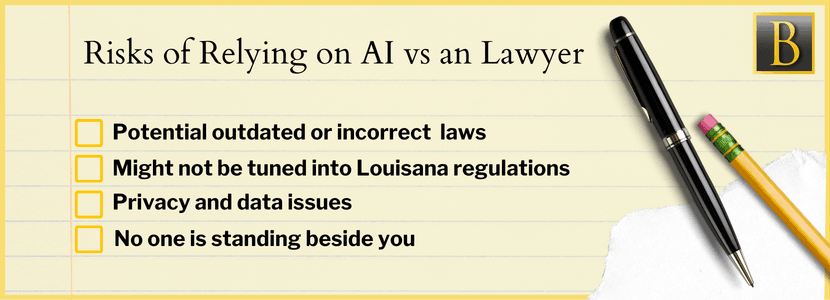
1. Incorrect or outdated laws
AI tools sometimes “hallucinate,” which means they confidently give wrong answers or even invent court cases that do not exist. The underlying AI algorithms may misinterpret legal rules or generate inaccurate information if not properly managed.
Judges across the country have sanctioned lawyers for filing briefs that relied on fake AI-generated citations.
Bottom line: If that can happen to trained attorneys, imagine how easy it is for AI to mislead someone who has never handled a claim before.
2. Not tuned to Louisiana
AI tools are trained on information from many states and countries. Louisiana has unique civil law roots and specific rules on fault, deadlines and insurance coverage. However, the training data for these tools may not include enough Louisiana-specific cases, which can lead to inaccurate advice for local legal issues.
Bottom line: A rule that is correct in Texas or California can be flat wrong in Lafayette Parish.
3. Privacy and data issues
Articles aimed at consumers have warned that:
- Chats are often stored by the company
- Staff or contractors may review some conversations
- In certain circumstances, AI searches can be requested in court
Strict adherence to privacy laws and ethical standards is essential when handling sensitive information with AI tools.
Bottom line: If you casually paste in your entire medical history and accident story, that is a lot of personal information in someone else’s hands.
4. No one is standing beside you
AI can explain what “settlement” means. It cannot:
- Call the insurance adjuster and push back on a low offer
- Prepare you for a recorded statement
- File a lawsuit in Lafayette, Jefferson or East Baton Rouge Parish
- Stand next to you at the courthouse
Bottom line: When you are facing a life-changing injury, that human presence matters. Only a real lawyer can develop a tailored legal defense to protect your interests in court.
How AI is Quietly Shifting the Way Many Injury Law Practices Handle Paperwork and Research
Because injury cases depend on accuracy, judgment, and personal details, AI is finding its way into support tasks, like as a smarter filing cabinet, research assistant, and document wrangler.
AI technology is revolutionizing the way legal professionals handle paperwork, research, and case management, making these processes faster and more efficient.
What AI Tools Can Do for Personal Injury Lawyers (Back Office Only)
From a back-office perspective, there are many new capabilities on the horizon for legal tools to use some sort of AI-assisted functionality. These tools can process and analyze vast amounts of legal, medical, and case-related data to improve efficiency.
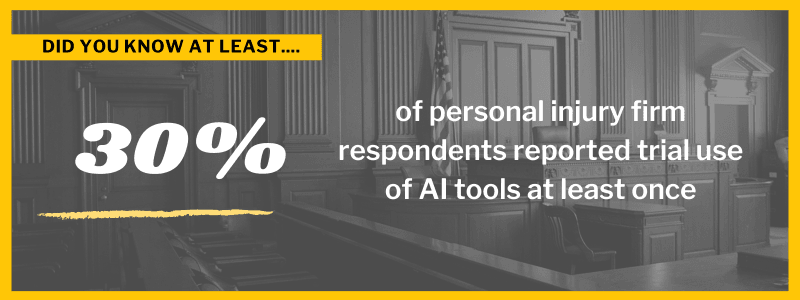
In the ABA’s most recent industry survey, more than 30% of personal injury firm respondents reported trial use of AI tools for at least one of the following functions, up from 11% two years ago.
Faster document review when there are lots of records
Tools like Logikcull or Everlaw use machine learning for eDiscovery to sort through piles of medical records, emails, and photos. They can group similar documents together, flag likely relevant ones, and reduce the manual monotony of early discovery. AI tools can also perform rapid analysis of documents to identify key evidence and issues.
Smarter legal research and case-law scanning
Other platforms like Casetext CoCounsel, Spellbook, or AI-powered research features built into top mainstream legal tools can comb through huge libraries of statutes and precedents. They can be used to highlight relevant decisions faster than a manual search. AI-powered research tools can also assist in drafting and reviewing legal motions for court proceedings, streamlining the preparation of essential documents.
Better case management, filing & workflow support
AI-powered tools are emerging for legal document review and to help prioritize important deadlines, sort large volumes of emails, track evidence, and even auto-draft routine letters or discovery requests. These tools enhance a law firm’s ability to efficiently manage complex cases and administrative tasks. In a high-volume personal injury practice, this can potentially shave off hours of administrative time for legal teams.
Streamlining e-discovery when the evidence is large
In bigger or more complex injury cases (for example, workplace injury, large-scale accidents, or long-term medical issues), AI-assisted eDiscovery tools help identify relevant documents or communications quickly. These tools can also leverage historical data from previous cases to improve the accuracy and relevance of document searches. That reduces cost and speeds up pre-trial work.
Why Many Injury Lawyers Remain Cautious and Why Clients Should Too
Using AI in back-office tasks can help a firm work smarter. AI is transforming personal injury law by streamlining processes and improving case management. However, it does not change what really matters: the lawyer’s judgment, local experience, and ethical responsibility.
Risk of mistakes and “hallucinations”
Some AI-powered research tools produce summaries with incorrect or made-up case law or references. Unless a lawyer carefully reviews everything produced by AI, such mistakes can lead to weakened arguments. Human oversight is essential for justice and fair outcomes.
Confidentiality and privacy concerns
Client data like medical records, accident reports and personal info is extremely sensitive. AI tools can also help detect potential fraud in insurance claims by identifying anomalies and inconsistencies.
If a firm uses cloud-based AI tools, it must adhere to data encryption rules, be securely stored and comply with ethical rules.
Not all tools are created equal, though, and ethical responsibility stays with the lawyer.
Even if a draft or summary is generated by AI, the lawyer must personally review and approve it. AI cannot “own” the case or make legal decisions.
Uneven adoption across firms
Large and mid-size firms lead the growth of AI adoption, with between 30-46% of those surveyed by the ABA’s Legal Technology indicating increased usage.
However, many smaller or boutique personal-injury practices avoid it altogether until security, oversight, and reliability are more established. In fact, less than 18% of smaller firms currently intend to use it until they better understand the risks and potential.
Business factors, such as firm size and available resources, play a significant role in the adoption of AI technology in legal practices.
What to Do After an Accident in Louisiana if You Have Already Used AI
If you typed questions into AI before you found this article, do not panic. Simply focus on the steps that protect your health and your claim.
- Get medical care right away. Tell your doctor exactly what happened and when.
- Save everything. Keep police reports, photos, repair estimates and any AI chats you relied on.
- Do not give detailed statements to an insurance company before legal guidance. The wrong wording can be used against you.
- Talk to a Louisiana personal injury lawyer as soon as you can. Share what AI told you so your lawyer can correct any bad information.
- Follow through with treatment and instructions from your doctor. Gaps in care can hurt your health and your case.
Don’t be embarrassed about searching in AI tools. Just make sure you aren’t relying on them to make big decisions, and protect your personal information from AI tools.
To receive the compensation you deserve, work with a real Louisiana lawyer who can advocate for your rights.
FAQ about AI and Louisiana Personal Injury Claims
If You’re an Injured Person in Louisiana, Should You Work With an Attorney Who Uses AI?
If you talk to a lawyer and they mention using AI tools behind the scenes, that does not mean your case is being “handled by a robot.” It likely just means the firm is trying to manage paperwork, evidence and deadlines more efficiently so the human lawyer can focus on strategy, your story, and the things that matter most.
When used appropriately, AI tools can help law firms improve client satisfaction by streamlining communication and case management. However, you are within your rights to do diligence and find out how and why your attorney uses AI before working with them.
Can I Use AI Instead of a Louisiana Personal Injury Lawyer?
You can use AI to learn general concepts, but it is not a substitute for a licensed Louisiana lawyer. It cannot represent you, give advice tailored to your facts, or appear in court on your behalf.
If a website or chatbot promises to give you full legal advice, draft your demand letter or negotiate with an insurance company, that is a red flag. AI can be used for supporting tasks, but it struggles to replace human judgment.
Should I Paste My Police Report or Medical Records Into an AI Chat?
You should be cautious. Many tools store chats and may review them, and some commentators warn that chats can be requested in legal proceedings. Do not share Social Security numbers, full medical histories or anything you would not want seen in public.
Will A Louisiana Judge Or Jury Care If I Used AI?
Judges care that filings and evidence are accurate and honest. Courts have already criticized lawyers who rely on AI-generated content without checking it. These are sometimes referred to as “AI hallucinations,” and judges around the country are sanctioning and reprimanding attorneys who get caught using fake AI citations.
For example:
- A Massachusetts court recently sanctioned an attorney for fictitious case citations generated by AI.
- In Alabama, a U.S. District Judge sanctioned an attorney in a high-profile drug case for using generative AI to draft a pleading with erroneous case citations.
If you used AI for high-level research for your own personal entertainment or curiosity, that may not be an issue, but you should always let your lawyer know if you’ve used it to draft any legal documentation.
How Much Does It Cost To Talk To A Real Lawyer Instead Of AI?
In personal injury cases, consultations are typically free and fees are paid as a percentage of the recovery. You can ask exact questions about fees during your first call with a Louisiana personal injury lawyer.
What Should I Bring To My First Meeting With A Louisiana Injury Lawyer?
Bring:
- Police report or accident number
- Photos and videos from the scene
- Insurance cards and letters
- List of medical visits so far
- Any AI printouts or screenshots you relied on
Your lawyer can sort through the details and correct everything AI got wrong.
How Blaine Helps Clients in Lafayette, Metairie, and Baton Rouge with Real-World Legal Support
Using AI may seem like an easy solution for immediate answers to your most burning legal questions, but there’s nothing like getting the right answers to your problems, not just “any answer.” Blaine and his team of licensed, legal professionals are highly responsive, and their customers have routinely rated the law firm for their quick, frequent and thorough communication.
Wherever you live, Blaine’s focus is the same: listen, explain the process in plain language, and help you make decisions that fit your life.
Lafayette
Blaine was born and raised in Lafayette and raised his family here. When someone from the Northside, Youngsville, or Broussard calls the office, they are talking to a team that drives the same roads and sits in the same traffic. That local perspective matters when you explain how a crash on Johnston Street or I-10 changed your daily life.
Metairie and the New Orleans Area
In Metairie, many crashes happen on busy routes like Veterans at Causeway or on I-10. Insurance companies often act like these are “standard” wrecks. Blaine’s team knows local doctors, body shops and adjuster tactics in this area, and uses that knowledge to build stronger claims for Metairie families.
Baton Rouge
Baton Rouge has its own traffic patterns and courthouse culture. A case involving a crash near LSU or an industrial site upriver can look very different from a fender bender in Lafayette. A real Louisiana personal injury lawyer can account for these differences. A generic AI chatbot cannot.
The Rest of Louisiana
Every part of Louisiana has its own roads, risks, and realities. Whether it’s a highway crash in Lake Charles, a refinery-related incident along the river parishes, or a rural accident on back roads in Acadiana, no two cases are exactly the same.
What matters is having someone who understands how these situations actually play out here. Blaine has spent decades working with people across Louisiana, helping them navigate the legal process while keeping things simple and straightforward. Because when something serious happens, you don’t need generic advice. You need someone who knows Louisiana.
When You’re Ready to Talk About Your Case, Skip the AI and Call Blaine
AI is here to stay. It can help you feel a little less overwhelmed, but it’s not suited to guide your legal future, health and safety.
If you were hurt in a crash or another accident anywhere in Louisiana, from Lafayette and Metairie to Baton Rouge, call Blaine and his team to talk about your options.
You get:
- A free, local conversation with a Louisiana personal injury lawyer
- Straight talk about your claim and your deadlines
- A team that may use modern tools, but never forgets that you are a neighbor first
In Pain? Call Blaine.