


When you’re hurt because of someone else’s negligence, the law gives you the right to pursue compensation for your medical bills, lost income, pain and suffering, emotional distress, reduced quality of life, and long-term care needs. The statute of limitations is set by Louisiana statutes, specifically the Louisiana Civil Code, which governs the time limits for filing civil claims.
But your right to recover is controlled by one of the most important deadlines in Louisiana injury law.
This deadline is called the statute of limitations, which is a legal limitation set by statutes that establishes the time limit for filing claims. For most Louisiana personal injury cases today, that deadline is two years.
Key Takeaways
- Most Louisiana personal injury cases now have a two-year statute of limitations.
- The statute of limitations is a legal limitation set by Louisiana statutes and the Civil Code.
- The previous status of limitations of one year ended for most injuries on or after July 1, 2024.
- Pre-July 2024 injuries are usually time-barred.
- Some case types still have shorter deadlines, including medical malpractice.
- Waiting makes it harder to gather evidence and easier for insurers to dispute your claim.
- A lawyer can protect your evidence and timeline even if you feel overwhelmed.
Louisiana Statute of Limitations: The New Two-Year Rule
In 2024, Louisiana updated its personal injury prescriptive periods. The most important change for injured people is simple:
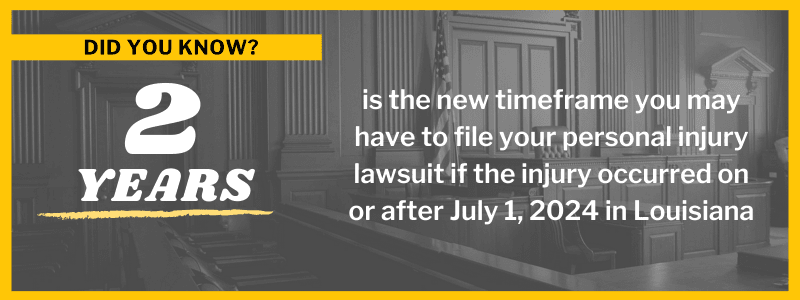
If your injury happened on or after July 1, 2024, you now may have two years to file your personal injury lawsuit.
This two-year deadline applies to most delictual actions, including:
- Car accidents
- Truck accidents
- Motorcycle accidents
- Slip and fall incidents
- Dog bites
- Product liability claims
- Wrongful death
- General bodily injury claims
- Damage to immovable property, including claims related to immovable property under the Louisiana Civil Code
The prescriptive period for these civil claims is now generally two years, as set forth in Louisiana Civil Code articles 3493.11 and 3493.12, and is a form of liberative prescription. The two-year prescriptive period applies to actions arising from injuries or damages that occurred on or after the effective date of the new law, July 1, 2024, which is a prospective application. Prescription commences on the day injury or damage is sustained or discovered, in accordance with the discovery rule.
Note that exceptions may apply, and plaintiffs should consult an attorney to avoid losing their right to file lawsuits if their claim becomes prescribed.
Louisiana’s statutes and state laws govern these time limits, and failing to act quickly within the prescribed time period may result in losing the right to pursue legal action. Product liability claims and cases involving permanent disability may have different time limits, such as a three-year period for certain claims. Extensive investigation may be required for some claims, so acting quickly is essential to preserve evidence and meet legal deadlines.
The one year prescriptive period (just one year) applied to actions arising before July 1, 2024, and the new two year prescriptive period applies to most claims arising after the effective date.If you were injured after July 1, 2024, then this is the rule that applies to you.
Reference Point: What About the Old One-Year Law?
Before July 1, 2024, Louisiana had a one-year statute of limitations for most personal injury cases (commonly referred to as the one year prescriptive period, as set forth in Louisiana Civil Code articles 3492 and 3493).
That historic year prescriptive period (just one year) applied to claims arising before the effective date one year of the new law. Now the law has changed.
The new two-year rule has prospective application, meaning it applies only to actions arising after July 1, 2024, the effective date. The two-year rule now governs almost all new personal injury claims.
Why the Two-Year Deadline Matters
Two years sounds like a long time, but it moves quickly. Evidence fades, witnesses move, and insurance companies look for any delay that suggests you are not taking the claim seriously. Louisiana’s comparative fault system also reduces your compensation if the insurer can argue you share responsibility. The longer you wait, the easier it becomes for them to shift blame. The time period for filing a claim is a strict legal time limit; if you wait too long, you may lose your right to recover.
Across the Acadian region, from Metairie to Lafayette and from Hammond to New Iberia, the two-year deadline starts the day the injury happens. Once the two-year mark passes, your claim may be lost permanently. If you do not file your claim within the prescribed time limit, your claim becomes prescribed and you lose the right to pursue it.
Your Two-Year Legal Clock: A Quick Mobile Checklist
Not sure where to start? Here are a few critical items for your legal to-do list. It is important to act quickly and consult an attorney to ensure all deadlines are met and your claim is properly handled.
First 7 days
As a plaintiff, consider prompt legal action to protect your rights and comply with statutory deadlines
- Get medical treatment right away
- Photograph injuries and property damage
- Write down what happened while the details are fresh
- Avoid recorded statements without legal guidance
- Seek representation from a personal injury attorney
Weeks 1 to 4
Gather documentation to support potential civil claims, such as evidence of personal injury, property damage, or other losses.
- Gather medical records
- Track missed work and expenses
- Save receipts and prescriptions
- Contact a Louisiana personal injury attorney
Months 1 to 12
Note the exact date the injury occurred or was sustained, as this determines your filing deadline.
- Continue treatment as directed
- Document symptoms and limitations
- Keep a simple pain journal
- Follow up on referrals and imaging
Months 12 to 24
Ensure your lawsuit is filed before the claim becomes prescribed, as missing the statutory deadline may bar your claim.
- Monitor long-term effects
- Evaluate future care or work limitations
- Prepare your legal filing deadline
- File your lawsuit before the two-year mark
Louisiana Injury Law: How Your Claim Is Evaluated
Louisiana injury law uses comparative fault, which means your compensation can be reduced if you are found partially at fault, as established by the Louisiana Civil Code governing civil claims and the applicable prescriptive periods. For example, if your claim is valued at $40,000 and you are assigned 25% fault, you could potentially recover $30,000.
This makes early evidence collection essential. The two-year prescriptive period for filing a civil claim gives you more space to heal and gather documents, but the sooner you start the legal process, the stronger your case can be.
Dog Bite Claims
Louisiana holds dog owners strictly liable for injuries caused by their dogs, regardless of prior bites. This is different from states with a one-bite rule.
Car Accident Claims
Drivers must carry minimum liability insurance, but many do not carry enough to cover serious injuries. Filing early helps identify available coverage and preserve crash evidence.
Louisiana Damage Caps: Medical Malpractice Is Treated Differently
While most personal injury claims follow the new two-year rule, medical malpractice claims follow different laws. The Louisiana medical malpractice statute of limitations is generally one year from the date of the negligent act or discovery of the act.
There is a three-year peremptive period that cannot be extended; however, certain product liability claims and cases involving permanent disability may have different deadlines under the relevant Louisiana Civil Code articles.
The three-year period applies to most medical malpractice claims, but product liability claims and claims involving permanent disability may be exceptions, as outlined in specific Louisiana Civil Code articles. Medical malpractice also has a $500,000 cap on damages, not including future medical care.
These special rules do not apply to standard injury cases like car accidents or slip and fall injuries.
Special Deadlines and Exceptions Two Two-Year Rule Does Not Change
While most personal injury cases now have a two-year statute of limitations, certain types of claims are subject to unique timing requirements. Only actions arising after July 1, 2024, are subject to the new two-year rule. These exceptions include:
- Medical malpractice
- Some wrongful death claims
- Claims against government entities
- Certain product liability discovery situations
- Claims involving minors or legally incapacitated adults
The two-year rule is the default, but exceptions still exist and should be reviewed with an attorney. If a lawsuit is filed after the applicable period, the defendant may raise an exception, arguing that the claim is time-barred.
If You Are Struggling With Money or Family Responsibilities
Recovery is stressful. Many injured people delay calling a lawyer because they are juggling:
- Child care
- Shift work
- Transportation issues
- Medical bills
- Helping aging family members
- Lack of paid time off
The two-year rule gives more breathing room, but delaying action still harms your case. If you do not file within the prescribed time limit, you may lose your right to compensation.
A lawyer can handle the paperwork, gather records, negotiate medical bills, and protect your filing deadline so you can focus on stabilizing your life.
Why Your Lawsuit Might Still Take Time
People often ask why their suit is taking so long. Common reasons include:
- Ongoing medical treatment
- Disputes over fault
- Insurance delays
- Record requests
- Negotiation timelines
- Court docket backlogs
These delays are normal, but missing your statute of limitations is not. Filing within the two-year period protects your right to continue negotiating or litigating without losing your claim entirely.
If you miss the prescriptive period, your claim is considered prescribed and you cannot pursue it further.
Talk to a Louisiana Statute of Limitations Personal Injury Attorney
The new two-year statute of limitations in Louisiana gives injured people more time to act, but the countdown begins on day one. If you are unsure about your deadline, do not wait.
It is important to consult a Louisiana personal injury lawyer for guidance on the statute of limitations and to ensure your claim is handled properly.
The Law Offices of Blaine Barrilleaux understand the Louisiana personal injury statute of limitations, as set forth in the Louisiana Civil Code, and how this new law affects your rights. We have helped thousands of individuals in the Acadian region protect their claims and move forward.
Contact us today for a free consultation. In Pain? Call Blaine.